|
Geoff Chidzey
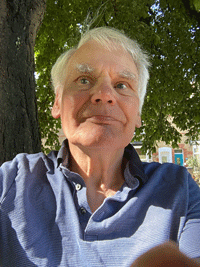 Upon retirement Geoff Chidzey joined the Trust
and brought a depth of engineering knowledge to
the Knowstone team. He says he needed something
to keep the old grey matter from seizing up,
having been employed as a vehicle technician for
all his working life, most recently with First
group at Taunton. His bus career started at
Taunton in 1964 with the Western National
Omnibus Company in the exalted position of shop
boy, the lowest of the low, under the watchful
eye of Hedley Scrivens, the Area Engineer. In
the August of 1964 he was accepted into the
company learnership scheme, but five and a half
years later the National Bus Company was formed
and learnership schemes became five year
apprenticeships. Suddenly he had served his term
and became a fitter. NBC not only took over
Tilling companies like Western National and
Southern National, but also the UK bus interests
of The British Electric Traction Co (BET) which
included Devon General. Manning levels at
Taunton reduced at about the same time as more
men were needed at Torquay, so Geoff spent
eighteen months working at Newton Road. After
that he moved to Tate & Lyle as a vehicle fitter
for about six months but found they were in the
process of moving to Southampton. Not wanting to
relocate he returned to Western National and
then subsequently became employed by the Cawlett
Group and finally First Group. Upon retirement Geoff Chidzey joined the Trust
and brought a depth of engineering knowledge to
the Knowstone team. He says he needed something
to keep the old grey matter from seizing up,
having been employed as a vehicle technician for
all his working life, most recently with First
group at Taunton. His bus career started at
Taunton in 1964 with the Western National
Omnibus Company in the exalted position of shop
boy, the lowest of the low, under the watchful
eye of Hedley Scrivens, the Area Engineer. In
the August of 1964 he was accepted into the
company learnership scheme, but five and a half
years later the National Bus Company was formed
and learnership schemes became five year
apprenticeships. Suddenly he had served his term
and became a fitter. NBC not only took over
Tilling companies like Western National and
Southern National, but also the UK bus interests
of The British Electric Traction Co (BET) which
included Devon General. Manning levels at
Taunton reduced at about the same time as more
men were needed at Torquay, so Geoff spent
eighteen months working at Newton Road. After
that he moved to Tate & Lyle as a vehicle fitter
for about six months but found they were in the
process of moving to Southampton. Not wanting to
relocate he returned to Western National and
then subsequently became employed by the Cawlett
Group and finally First Group.
Robert Crawley - Chairman
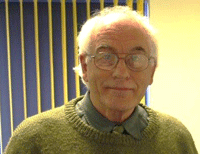 When
recently asked how long had he served as a
Trustee, Robert had to quickly think back to
2000, when he was invited to be one of its
earliest Directors. Championing the archive
has been Robert’s main responsibility and some
may regard him as an archive exhibit himself,
having served the Trust for that length of time
and as Chairman since 2008. The idea of WHOTT
captured his imagination back in 1999 when he
was first approached with the vision of a museum
that he thoroughly endorsed. The objective was
ambitious and a desire to see it flourish was
paramount in Robert’s mind. That situation
still exists because this region has a lot of
commercial transport history that should be
protected. Way back in one of the early
editions of WHOTTs NEWS there were some words
describing Robert and what he could bring to
this organisation. Having had a childhood
admiration for buses and coaches in his native
Exeter and living within a stone’s throw of some
bus company managers, it didn’t take long for an
introduction to come his way and to apply for a
job in the engineering department of Western
National’s head office. So it was there that he
started in 1961, actually getting paid for
something he loved doing. Not that the salary
was anything to get excited about but it must be
said that, in all the years he was in the
industry, Robert noticed there were a good
number of people who were loyal to the job
rather than putting up with their pay packet.
It then struck him that there was a huge
camaraderie amongst busmen – and women – indeed
marriages were forged on lonely bus routes and
at Head Office where he worked, his future wife
emerged from the wages department! It was then
that he realised that behind buses was a most
interesting aspect of social history and
sub-consciously he was drawn into investigating
what the company was made of, where it had
originated and who tugged its strings. The
vehicles and services just happened to be a part
of the whole, for the industry was largely
people driven and public carrying. With that
combination there was a story to tell, so with
some friends he turned to writing up notes and
persuaded his wife to type them, which
eventually resulted in a three-volume trilogy of
the company’s history. The bus company gave him
25 memorable years of service but the axe of
redundancy eventually fell and so to other
avenues that, with the benefit of hindsight,
opened up fresh opportunities and perfecting old
skills. From now on Robert would no longer be
sitting at a desk pushing a pen, but driving
hundreds of miles around the country with a box
of tools maintaining and tuning church organs.
Now semi-retired, Robert feels that there is
still much to contribute in various directions
that interested him, such as vintage car
restoration, playing ‘cello in the ISCA
orchestra as well as pursuing other interests in
natural history, astronomy, architecture,
genealogy and maritime history. When
recently asked how long had he served as a
Trustee, Robert had to quickly think back to
2000, when he was invited to be one of its
earliest Directors. Championing the archive
has been Robert’s main responsibility and some
may regard him as an archive exhibit himself,
having served the Trust for that length of time
and as Chairman since 2008. The idea of WHOTT
captured his imagination back in 1999 when he
was first approached with the vision of a museum
that he thoroughly endorsed. The objective was
ambitious and a desire to see it flourish was
paramount in Robert’s mind. That situation
still exists because this region has a lot of
commercial transport history that should be
protected. Way back in one of the early
editions of WHOTTs NEWS there were some words
describing Robert and what he could bring to
this organisation. Having had a childhood
admiration for buses and coaches in his native
Exeter and living within a stone’s throw of some
bus company managers, it didn’t take long for an
introduction to come his way and to apply for a
job in the engineering department of Western
National’s head office. So it was there that he
started in 1961, actually getting paid for
something he loved doing. Not that the salary
was anything to get excited about but it must be
said that, in all the years he was in the
industry, Robert noticed there were a good
number of people who were loyal to the job
rather than putting up with their pay packet.
It then struck him that there was a huge
camaraderie amongst busmen – and women – indeed
marriages were forged on lonely bus routes and
at Head Office where he worked, his future wife
emerged from the wages department! It was then
that he realised that behind buses was a most
interesting aspect of social history and
sub-consciously he was drawn into investigating
what the company was made of, where it had
originated and who tugged its strings. The
vehicles and services just happened to be a part
of the whole, for the industry was largely
people driven and public carrying. With that
combination there was a story to tell, so with
some friends he turned to writing up notes and
persuaded his wife to type them, which
eventually resulted in a three-volume trilogy of
the company’s history. The bus company gave him
25 memorable years of service but the axe of
redundancy eventually fell and so to other
avenues that, with the benefit of hindsight,
opened up fresh opportunities and perfecting old
skills. From now on Robert would no longer be
sitting at a desk pushing a pen, but driving
hundreds of miles around the country with a box
of tools maintaining and tuning church organs.
Now semi-retired, Robert feels that there is
still much to contribute in various directions
that interested him, such as vintage car
restoration, playing ‘cello in the ISCA
orchestra as well as pursuing other interests in
natural history, astronomy, architecture,
genealogy and maritime history.
Ralph Ellis
 Ralph
was born in Winchester, Hampshire in May 1952
and the family lived in Eastleigh. Interest in
public transport came early with the London &
South Western Railway’s Locomotive workshops,
Carriage and Wagon Works plus the huge running
sheds all within earshot of his home in
Bishopstoke. On the bus side Ralph remembers
going to school on Hants & Dorset Bristol Ks
until one day when a strange bus with a door at
the front turned up on service 48 – H & Ds first
FLF. Hants & Dorset’s bus station and depot in
Blenheim Road, Eastleigh stood adjacent to the
main line through the town. Ralph
was born in Winchester, Hampshire in May 1952
and the family lived in Eastleigh. Interest in
public transport came early with the London &
South Western Railway’s Locomotive workshops,
Carriage and Wagon Works plus the huge running
sheds all within earshot of his home in
Bishopstoke. On the bus side Ralph remembers
going to school on Hants & Dorset Bristol Ks
until one day when a strange bus with a door at
the front turned up on service 48 – H & Ds first
FLF. Hants & Dorset’s bus station and depot in
Blenheim Road, Eastleigh stood adjacent to the
main line through the town.
A career in public transport began in October
1973 when Ralph joined Hants & Dorset Motor
Services Ltd in the Tours Department at Bedford
Place Coach Station, Southampton – now alas,
long gone. In November 1974 he joined National
Travel South West Ltd at the Extended Tours
office in Exeter. Part of the NTSW empire was
Greenslades Tours Ltd and Ralph undertook
temporary depot management roles during 1975 and
1976 in Torquay and Plymouth before being
appointed Depot Manager in the Torwood Street
Coach Station, Torquay late 1976.
Ralph returned to the Greenslades Exeter office
in Spring 1978 on the brink of a real change in
direction that summer. Joining the Western
National Omnibus Company Ltd Ralph became part
of the Company’s Market Analysis Project (MAP)
team with Roy Anderson and Robin Wilding. From
the autumn Ralph prepared surveys and completed
data analysis for various depots across the
Western National, Bristol Omnibus and National
Express companies.
In January 1981 Ralph began the Plymouth Joint
Services MAP as the Western National’s
representative on the team with Plymouth City
Council and Plymouth City Transport. As this
Project neared completion he was offered a
position with Plymouth City Transport, joining
the team at Milehouse in the Spring of 1982.
Plymouth City Transport became Plymouth Citybus
Ltd and during his time, firstly as Market
Development Officer, then promoted to Traffic
Manager, the MAP network was introduced which
marked the beginning of Plymouth Citycoach
activities and the registration of the
commercial network in October 1986.
Tempted back to coaching activities, Ralph
joined the newly-privatised Western National Ltd
in August 1987 as National Express Manager. At
that time this work was a major part of the new
Company’s business with scheduled diagrams
operated by Penzance, Truro, Newquay and
Plymouth depots. For the first time since
joining the industry Ralph was now in the
private sector and the difference in outlook and
commercial discipline was very marked.
Finally in the Spring of 1998 Ralph left the bus
industry and joined Plymouth City Council on its
rebirth as a Unitary Authority under Local
Government Reorganisation. He was appointed
Public Transport Officer, firstly supervising
Special Education Needs School Transport, Social
Services Transport and Dial-A-Ride. From January
2006 he became part of the Public Transport Team
looking after Tendered Bus Services, Park &
Ride, Local Railways, Concessionary Bus Passes –
and complaints!!
After retirement in September 2020 Ralph’s
interest in public transport continued with
membership of the Devon General Society, WHOTT,
the South Devon Railway Association, plus proof
reading timetables for Plymouth Citybus and Go
Cornwall. Ralph maintains this helps to keeps
the brain active and a chance to suggest changes
and enhancements to the Go South West team at
Milehouse!
Away from buses, coaches and trains Ralph enjoys
dog walking at the Woodside Animal Sanctuary
near Plymouth, reading and catching up with
friends and colleagues made during those fifty
years in the industry.
Tony Hazell
 At
a young age Tony became interested in
trainspotting during the final years of steam.
He then developed an interest in buses, spending
many hours at Exeter's Paul Street bus station.
In the sixties Tony met up with the late Colin
Shears and became involved with his vast "Winkleigh"
collection of rescued and preserved vehicles. At
a young age Tony became interested in
trainspotting during the final years of steam.
He then developed an interest in buses, spending
many hours at Exeter's Paul Street bus station.
In the sixties Tony met up with the late Colin
Shears and became involved with his vast "Winkleigh"
collection of rescued and preserved vehicles.
In 1971 this encouraged Tony to buy his first
vehicle an Albion Victor coach which he still
owns today, together with a former Devon General
Leyland PD2 acquired in 1975. These vehicles
have attended numerous events over the years.
In 1984 Tony’s hobby became a livelihood when he
started a family bus and coach business which,
after forty years, is now continued by his
daughter. During his time as an Operator both
his Albion and PD2 were upgraded to Class 6 for
use for hire and reward. Having been an
original member of WHOTT, Tony’s involvement has
become more intense since retirement and the
passing, in recent times, of his good friend and
WHOTT member, David Godley. David had shared
much of Tony’s interests in public transport
since school days.
John Roberts
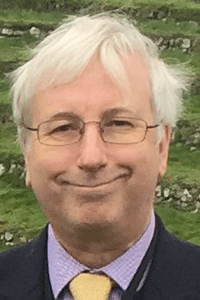 John hails from mid-Cornwall and by the age of
two could differentiate types of steam loco,
lorries and buses. After founding the Tremorvah
School Bus & Lorry club, and the Truro School
model railway society, he went up to Surrey
where he started the University railway society.
Reading civil engineering, he joined British
Rail and rose to senior project manager of the
Channel Tunnel and Crossrail. After
privatisation, he became a transport advisor to
Her Majesty's Government. John hails from mid-Cornwall and by the age of
two could differentiate types of steam loco,
lorries and buses. After founding the Tremorvah
School Bus & Lorry club, and the Truro School
model railway society, he went up to Surrey
where he started the University railway society.
Reading civil engineering, he joined British
Rail and rose to senior project manager of the
Channel Tunnel and Crossrail. After
privatisation, he became a transport advisor to
Her Majesty's Government.
Over the years, John has restored several
classic cars and buses. His other interests
include industrial archaeology, music and
campanology. At various times he was or is a
member of Truro St Mary's Parochial Church
Council, Truro Diocesan Guild of Ringers, Vice
Chairman of Croydon YMCA, a Liveryman of the
Worshipful Company of Engineers and Secretary to
the Engineers' Trust, plus Events Officer for
the Routemaster Operators & Owners Association. |
